

Donald J. Trump seemed to recenter political gravity ten years ago by motivating a group of voters who rarely turn out to cast their ballots.
His lucky breaks in 2016 and 2024 have since evaporated. He won the latter race by promising lower costs and no wars. Since taking office a second time, his decisions have directly caused higher prices and he’s actively exhausting the country’s supply of missiles.
A steady drumbeat of chaos and broken promises cratered Trump’s approval rating to unprecedented levels, activating tens of millions of voters to punish his Republican Party in a historic drubbing on Tuesday night.
These losses weren’t confined to just marquee congressional races. Republicans faced decimation at the state and local levels in a wipeout from which it will take many election cycles to recover–if they recover at all in some areas.
Democrats are on track to flip around 40-45 seats in the U.S. House and 7-9 seats in the U.S. Senate, which is the party’s strongest midterm performance since Watergate in 1974.
Almost every tossup seat went to the Democrats, including many more that had been considered ‘safe’ for Republicans until very recently.
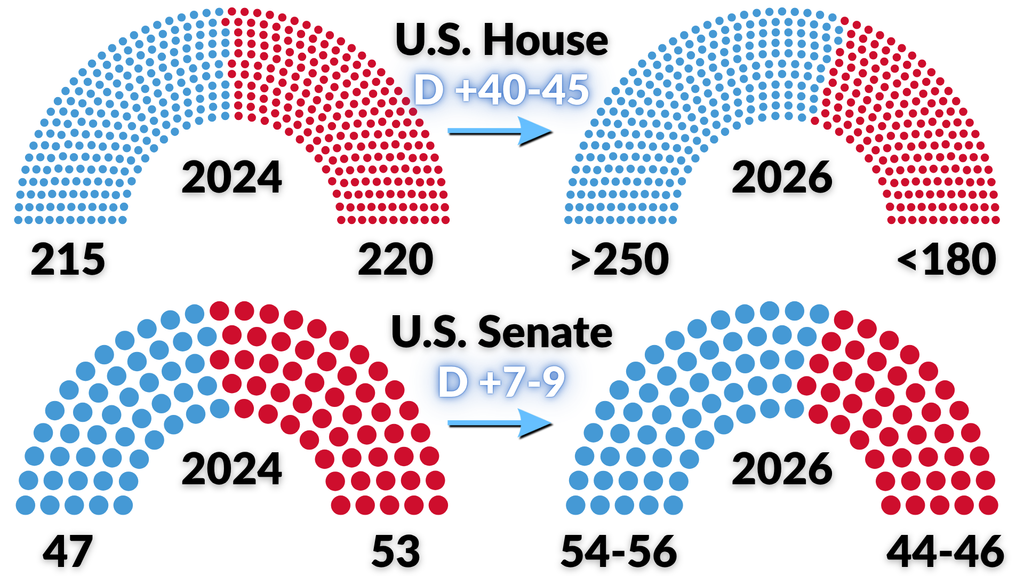
The size and scope of the victory is immense.
Kansas elected Adam Hamilton as its first Democratic senator since 1932. James Talarico will be Texas’ first Democratic senator since Lloyd Bentsen left office in 1993. Annie Andrews’ shock victory in South Carolina will make her the state’s first Democratic senator since Fritz Hollings won reelection in 1998. Political realignments since those entrenched senators’ terms made Democratic victories unthinkable just six months ago.
None of these candidates won in a squeaker, either. Talarico secured a 12-point victory in Texas, which is larger than the margin won by his Republican predecessor in 2020. Hamilton and Andrews each beat the incumbents by 4-5 percent. Susan Collins (R-ME), long seen as a unique survivor against political headwinds, faced a resounding defeat by Troy Jackson. (Very concerning!)
Scott Colom’s narrow lead over the incumbent Republican in Mississippi likely sends the race to a protracted recount. He would be Mississippi’s first Black senator since the 1870s.
The House of Representatives will look far different than it has in many years. Democrats are on track for a blue majority not seen in almost 35 years.
The gerrymandering wars that Republicans started earlier this year backfired spectacularly. Party leaders in North Carolina, Florida, and Tennessee spread their vote thin enough in an effort to cement power that the enormous leftward swing instead swamped the party’s candidates.
Such a backfire caused a near-wipeout of North Carolina’s congressional delegation. Republicans held 10 out of 14 seats going into last night, and the party had expected to gain an additional seat through its new map. Democrats are now on track to hold 9 or 10 of those 14 seats.
It’s the state results that reflect the shocking depth of Republican losses, particularly across the South. Led by a presidential-level Black turnout, voters here didn’t just elect a few token Democrats–they delivered an old-fashioned whooping.
Democrats flipped every single statewide office in Georgia: governor, lieutenant governor, attorney general, secretary of state, school superintendent, and the commissioners of agriculture, insurance, and labor.
Democrats also flipped every single statewide office up for election in Texas: governor, lieutenant governor, attorney general, agriculture commissioner, comptroller, land commissioner, four seats on the state supreme court, and control of the board of education.
Democrats are on track to have flipped hundreds of the 6,143 state legislative seats up for election this year. At least 11 chambers are projected to change hands, and several more have seen their Republican supermajorities broken.
State and local results have national implications.
Securing chambers and breaking supermajorities could stop further gerrymanders aimed at influencing control of Congress. Winning critical attorney general races, for example, will stem the tide of lawsuits aimed at undoing civil rights.
Decisions made by Texas’ State Board of Education affect the content included in many textbooks distributed to students across the U.S. These choices heavily influence how school systems nationwide teach subjects like biology, earth sciences, and history.